Shipwreck of Paul
Acts of the ApostlesThe Shipwreck of Paul is the perilous sea voyage that carries Paul, under Roman guard, toward Rome and ends with the vessel breaking apart near an unfamiliar shore. Its decisive significance is not a smooth or effortless rescue: the passengers and crew survive through warnings, shared action, and unexpected intervention, while Paul’s mission remains directed toward witness in the imperial city. In the journey’s governing image, the sea is chaos, but the story insists that chaos does not have the final word.
A voyage under warning
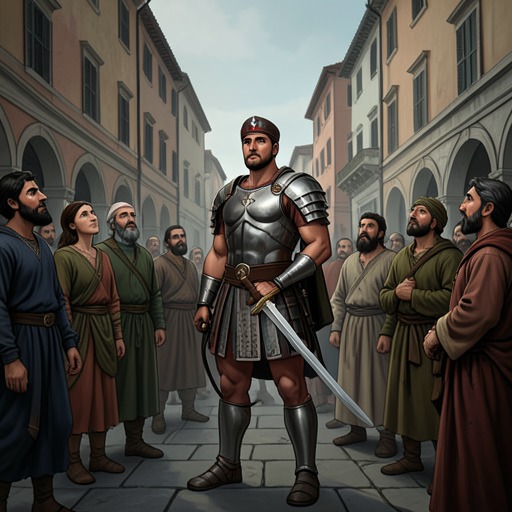
Paul is transported from Caesarea to Rome in the custody of Julius, a centurion of the Augustan Cohort, a prominent unit of the Roman army named for Caesar Augustus. The title Augustus means “revered,” an imperial claim the narrative quietly places beside the unexpected service of Julius, who preserves Paul for a witness in Rome without intending to serve that purpose. The voyage thus begins within Roman power, but the centurion’s conduct will not simply reproduce its harshest possibilities.
The first days at sea are uneventful. The party sails from Adramyttium to Myra, where it changes ships, and Julius treats Paul kindly. From Myra the sailing becomes difficult as the vessel struggles against the wind toward Fair Havens. The delay carries them into the fall, when dangerous weather is increasingly likely; the Fast, the Jewish Day of Atonement in September or October, has passed. Paul warns that the voyage will bring loss of cargo and danger to life. The ship’s leaders do not follow his judgment. Because the harbor is unsuitable for winter, they put out to sea in hopes of reaching Phoenix.
The warnings matter in part because Paul is a prisoner, not one of the conventional authorities directing the ship. The centurion, pilot, and owner confer among themselves, while Paul reads the circumstances and anticipates what follows. His warning is presented as prophecy, yet the account also stresses that he attends to conditions around him. Its contrast is between credentialed or customary authority and insight coming from an unlikely source—not between practical attention and faith. The danger becomes a test of whether a community will listen before events force recognition.
Storm, loss, and assurance
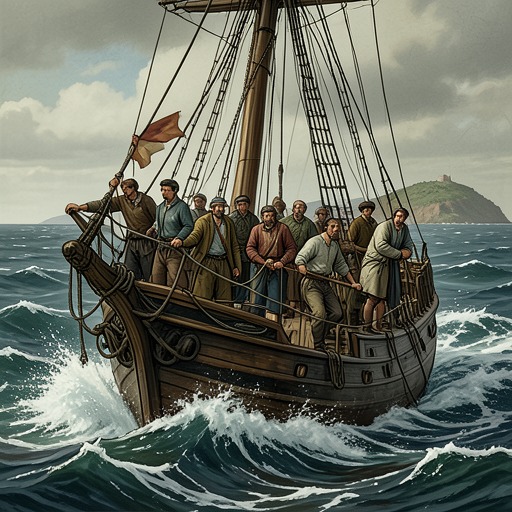
Soon after leaving port, a violent wind makes the vessel unmanageable. Attempts to control it fail, and the crew lowers the sea anchor to avoid being driven onto Syrtis. The next day they throw cargo overboard; when that does not suffice, they cast the ship’s tackle away as well. The sun and stars disappear in the tempest, removing the means of navigation. The narrative marks the depth of the crisis in the abandonment of hope that anyone will be saved.
The episode is arranged as a movement from desperation toward hope, not as a denial of the danger. Paul points out that the crew should have listened earlier, a rhetorical move that could sound arrogant if delivered without care. Yet he also urges them to keep their courage. During the storm an angel assures him that he will stand before the emperor and that everyone aboard will reach safety. That assurance does not promise a comfortable arrival: the means of survival will be running aground on an island. The promise concerns the preservation of life and Paul’s mission, not the preservation of the ship.
The storm also sharpens the ship’s place within the larger journey of Luke-Acts: from Galilee to Jerusalem, through Judea and Samaria, and toward the ends of the earth. The sea’s chaos makes the route’s peril visible, while the predicted landing carries the story onward toward Rome and the Gentile mission. The storm is therefore both a concrete threat and a narrative trial in which confidence has to persist without control over the outcome.
Holding together and breaking bread
Around midnight, the sailors believe the ship is close to land. They take soundings, lower four anchors, and wait for daylight to assess their position. Some then try to leave in the small boat, pretending that they are going to put out anchors. Paul tells the soldiers that the sailors must stay aboard if the crew and passengers are to be saved. The soldiers call the sailors back and let the small boat drift away.
The reversal is practical and communal: the sailors cannot secure their own escape while abandoning the people whose survival depends on their work. Paul’s warning gathers the group back into a shared task, and the narrative makes their collective survival depend on maintaining the community aboard. His role has shifted from a prisoner whose advice was discounted to a voice whose guidance the soldiers act upon.
Paul also urges everyone to eat so they will have strength. He says that none will lose a hair of their heads, recalling Jesus’ assurance that God numbers even the hairs of the head. Paul takes bread, gives thanks, breaks it, and eats. The sequence of taking, giving, and breaking links the meal to the Lord’s Supper and to the breaking of bread through which Luke associates the risen Jesus’ presence with his followers. The meal has an immediate purpose—the people need strength—but it also signifies that the presence of the risen Jesus sustains Paul amid the storm. The others eat as well, and afterward they throw the remaining wheat cargo overboard. The ship is lightened further, and its passengers are left to rely on God’s providence.
The wreck and the rescue
At daybreak the travelers see land but do not recognize it. They try to run the ship aground, following Paul’s advice, but it strikes a reef. The bow becomes stuck, and the stern begins to break apart. The expected safety is suddenly near, yet the ship itself is lost. The landing is not the smooth outcome planners might want; nevertheless, the earlier assurance is fulfilled in a different form. The wreck interrupts the vessel’s passage without ending the witness it was carrying.
A final danger comes from the soldiers. With land close by, most want to kill the prisoners so none can escape; if a prisoner gets away, Rome may hold the soldiers accountable and punish them severely. Julius intervenes and persuades them to abandon the plan. He orders everyone to leave the ship, and the survivors reach shore by swimming or holding onto pieces of the vessel. Everyone aboard is saved. The Roman centurion who had treated Paul kindly now protects him from a Roman threat, an unexpected intervention that helps preserve Paul for the journey’s next stage.
Narrative pattern and significance
The shipwreck belongs to a larger pattern of danger and assurance in Luke-Acts. Near the beginning of the Gospel, Jesus is born amid difficult circumstances; near the end of Acts, Paul survives the destruction of the ship. The parallel does not make the two episodes identical. It places them as parentheses around a narrative in which witness to the Realm takes place amid hardship, while affirming that God’s purposes can continue within circumstances that appear to threaten them.
The episode also resists a triumphalist reading of rescue. Paul reaches safety, but not through a controlled passage or an intact ship; everyone survives by leaving the wreck and reaching land as they can. The outcome is secure in one sense and unsettled in another: the ship is lost, the journey has been disrupted, and the promised destination still lies ahead. In this way, the story’s confidence rests less on the success of a particular plan than on the preservation of life and witness through crisis.
The book’s interpretation invites attention to the people who are easy to overlook, to the need to read actual circumstances rather than wishful expectations, and to the work of keeping a threatened community together. These are interpretive applications drawn from the episode, not claims that the storm is an allegory for every crisis. Its concrete details—the failed voyage decisions, four anchors, abandoned cargo, shared bread, the reef, and Julius’s intervention—give those applications their shape. The shipwreck carries Paul toward Malta and ultimately Rome, while showing how the journey’s witness persists through conflict, loss, and assistance from unexpected sources.